
As difficult as recovery is, Opioid Use Disorder patients can make full recoveries. But they often need full medical support, professional therapy, and clinical staff to complete this tough journey.
However, in California counties with few licensed rehab facilities, searching for quality rehab care can feel like walking in a desert. In some spots, there are no fentanyl treatment centers to be found, or long, desolate miles between each one.
We asked our researchers to calculate the counties with the biggest rehab deserts in the state. Those are the places with the largest populations, the most tragic overdose deaths, but the fewest licensed drug rehab centers to count on for help.
What Is a Drug Treatment Center Desert?
“Fentanyl Treatment Deserts” is a term we are using to describe counties in California that need far more drug treatment centers than they currently have.
It’s a wasteland of sorts for dependable care for patients who often require full-time monitoring. Finding an inpatient program nearby is also critical. In one of our “deserts,” families will have real trouble finding that care.
A void in available care forms a desolate landscape for patients and their families.
We will explain how we assigned the desert label to different counties below.
But basically, counties with higher fentanyl overdose death rates and a lower number of rehabs were marked as deserts.
The Numbers Behind Fentanyl Treatment Deserts
We launched a study to identify the largest gaps in drug treatment services. We started by calculating the fentanyl overdose death rates per 100,000 people in each county. This allowed us to compare counties with very different populations fairly and easily.
Then we compared those death rates with the number of rehab beds available at the licensed facilities in each county. The counties that had the highest death rates compared to the fewest available rehab beds were deemed rehab deserts.
The analysis merges 2024 statistics from DHCS licensed facility data and CDPH fentanyl death data, along with the most recent population counts.
This is a look at the top ten counties with the biggest fentanyl treatment center gaps between need and actual detox service providers. (Death rates are age-adjusted)
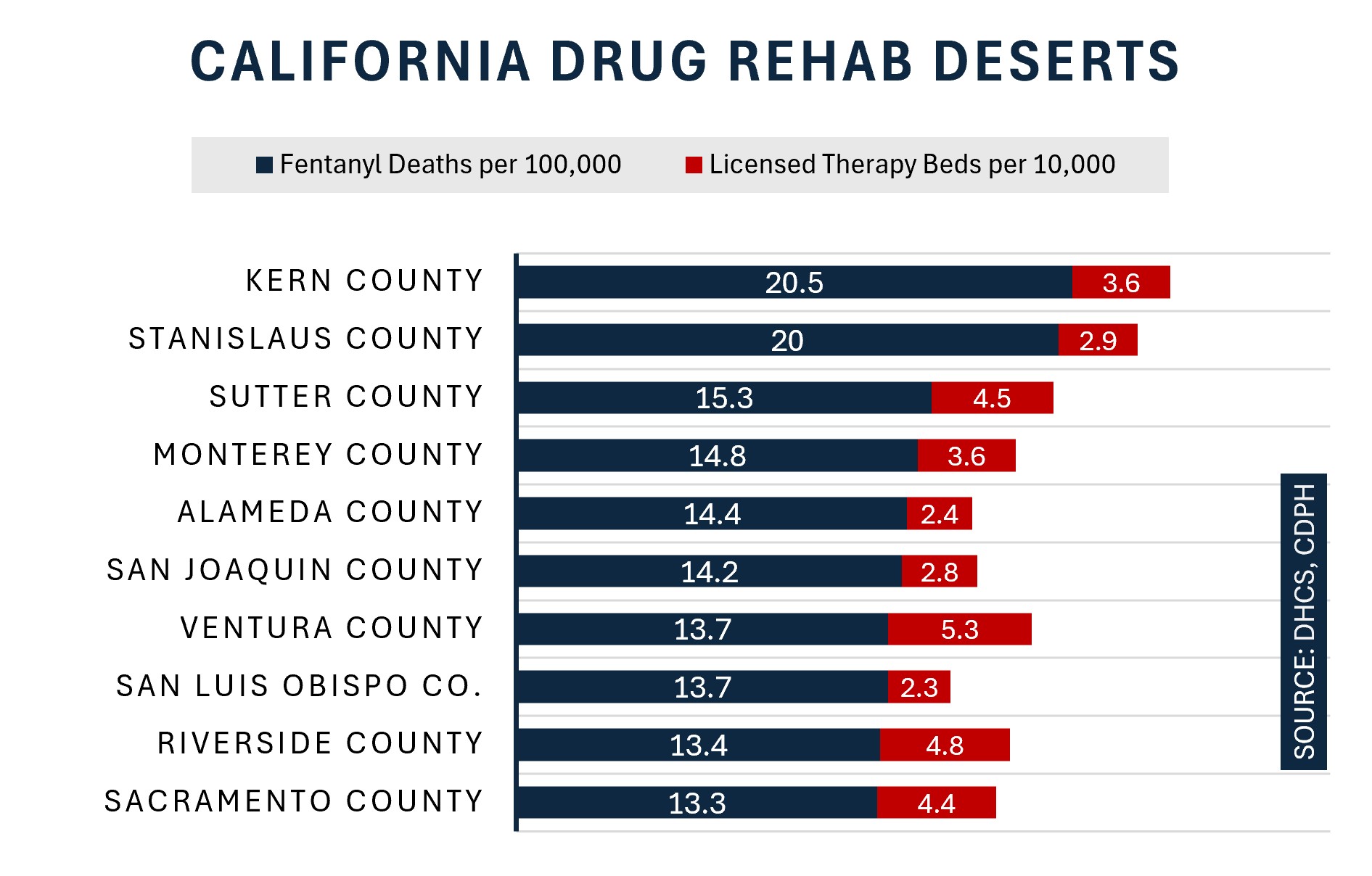
The average fentanyl deaths per 100,000 people is 12.85 among all 58 counties.
The average number of licensed rehab beds per 10,000 people in all counties is 5.4.
It should be noted that the number of treatment beds in each county does not include Sober Living Homes. These are usually unlicensed residential homes that only provide room and board, peer support, and supervision for recovering fentanyl use patients.
Takeaways from California’s Drug Treatment Center Deserts
This list of facility-barren regions definitely highlights a sad truth. Treatment capacity is highest where the rehab business is booming, but that’s not always where the most deaths are.
Five Southern California counties (LA, Orange, San Diego, Riverside, San Bernardino) hold 64% of the state’s 21,342 licensed beds. These counties are destinations for therapy seekers from across the globe.
What’s more, Orange County has 163 licensed facilities and 6.5 beds per 10k, while Bakersfield and Kern County, with a fentanyl death rate 66% higher than Orange County, have 3.6 beds per 10k.
Our list of the top drug therapy deserts is largely filled with three types of communities:
- The rural counties with low populations. Some of these counties were left off, but they can still suffer from too few services. These counties may still record a tragic number of drug overdoses each year, but provide very few places where sufferers can get help. Sutter County probably fits in this category. It’s a county with 98,545 people and reporting 14 fentanyl deaths in 2024. Yet, the county has only 4 licensed drug treatment centers.
- Hotspots for Opioid Use Disorder (OUD) sufferers. These places may have many rehab facilities, but for the number of patients they receive from across the nation, they could definitely benefit from more. Riverside County is a very popular rehab destination. The county is home to 2,529,933 people. It documented 323 fentanyl overdose deaths in 2024. It’s the location for 65 drug rehabs with 1,224 beds available. Yet, according to our research, the county needs more facilities to safely handle the demand for care. Ventura County is another prime location for rehab businesses, but by our count, the area should have more beds to meet the need.
- Larger cities outside the Southern California bubble. These include Stockton in San Joaquin County, Modesto in Stanislaus County, and Sacramento. They have big populations, growing fentanyl issues, but too few beds for their size.
What Counties Were Left Off?
Counties with tiny populations, such as Alpine County with just over a thousand residents, were excluded from this list.
They are not immune to fentanyl abuse, but their few reported deaths and low population make projecting their fentanyl death rates to compare to much larger counties inaccurate.
What’s more troubling is that many of these small counties have no rehab facilities within their borders.
This is a list of the California Counties with no licensed drug rehab facilities in 2026: Alpine, Colusa, Del Norte, Glenn, Imperial, Inyo, Lassen, Modoc, Mono, Plumas, Sierra, Siskiyou, Trinity.
Why Exposing Treatment Deserts Is Important
In places where drug programs are few and far between, or nonexistent, families get put in difficult and emotional dilemmas. They are often forced to consider a long trip to an area with more detox centers available.
It’s an added cost. They must also weigh leaving a loved one alone in a strange place during the most difficult challenge of their life.
A Long Drive for Drug Rehab Services
This trip can make recovery even harder for fentanyl use disorder patients. Once checked in, they may not get the support of loved ones who can’t afford to stay nearby.
Families may not be able to provide daily visits. They may also not be around when a negligent rehab releases a patient without warning.
Risk of Negligence
There’s also a question of safety in places where the streets are virtually lined with rehabs. Patients may end up in areas like Orange County’s so-called “Rehab Rivera.” It’s a nickname given to the county’s coastal cities, like Costa Mesa. There are many facilities located here, drawing patients from across the world. Many specialize in providing luxury amenities, like a European resort.
In places like these, there’s more chance of rehabs, especially luxury rehabs, providing services they aren’t licensed to offer.
There’s more chance for profit-hungry companies and corporations to cut staffing at high-priced facilities, boosting profits but leaving patients without the attention they need. Negligent-operator lawsuits pop up yearly.
Families can pay a lot of money for a lower quality of care and even end up losing a precious loved one to facility carelessness.
Finding Solutions to Drug Rehab Deserts
Cities, counties, and healthcare providers should partner to reduce these deserts. The holes in coverage should be identified. Shrinking them should be the goal.
No family should be more than an hour’s drive from a reputable drug treatment provider. No family should have to choose between an expensive trip, expensive rehab care, and the life of a loved one.
The consequences are no secret. Without proper help charting a path back to normal life, patients trying to recover on their own can quickly relapse. They often suffer life-threatening withdrawal complications or become the victims of a deadly overdose. These tragic outcomes aren’t the victim’s fault, and they can be avoided.
Taking Action After a Drug Rehab Tragedy
When loved ones are allowed to harm themselves or overdose while under the care of a rehab facility, they should not be blamed.
Find out how long families have to file a lawsuit against a negligent California drug treatment center and how a lawyer can help.