
The “Rehab Riviera” is a term given to the coastal area of Orange County. It’s a negative nickname to describe a string of cities that quickly became the preferred landing spots for dozens of drug rehab providers.
The Orange Coast is definitely a beautiful setting, and there are plenty of recovery beds available. But the sunshine and the resort vibes can mask danger for patients who check in.
Some facilities charge exorbitant amounts, but the service and care don’t always match the price tag. Other facilities offer therapy and medications they aren’t licensed to provide. These and other problems have been putting vulnerable patients at risk for decades in the Rehab Riviera.
2000s-The Rehab Riviera Under Construction
The Rehab Riviera is a handle that’s stuck hard to the booming rehab treatment industry in Orange County. Coastal towns like Newport Beach, Huntington Beach, and Laguna Beach became a concentrated center for licensed drug rehabs and non-licensed recovery residences.
The rise of the Riviera is said to have started in the late 2000s. Rehab owners and parent corporations found the locale desirable and the laws welcoming. More people found they could afford weeks at a rehab facility as health insurance plans approved coverage.
The companies, corporations, and organizations running drug clinics also saw an opportunity to attract patients from nearby Los Angeles County, and perhaps further out.
These are just a few of the reasons experts believe the region’s drug programs exploded at this point in time:
- Substance Abuse and Crime Prevention Act of 2000: This legislation was cited by the Costa Mesa city council as a major contributor to the demand and investment popularity of treatment homes. It provided first-time drug offenders the chance to enter rehab instead of facing jail time.
- Additional Insurance Coverage: The Mental Health Parity and Addiction Equity Act of 2008 forced health insurance providers that did cover drug rehab to treat mental health issues and substance abuse the same as other illnesses. This made getting a rehab trip paid for much easier for many.
- Patients from Other States: Rehabs in Orange County began to focus more on out-of-state recruitment.
- Luxury Environment: The idyllic setting along the Orange Coast is easier to market to potential patients in the Midwest and on the East Coast, as reported by the LA Daily News.
- No Oversight: Almost non-existent regulation of Sober Homes allowed rehab businesses to set up shop in any home in any residential neighborhood in places like Huntington Beach. Also, almost anyone, even a homeowner, could open a sober living home and collect rent from many tenants.
2010s- Rehab Riviera Gains Infamy
Attendance and attention rose in the 2010s. Patients became much more valuable to drug treatment centers as more health insurance providers were forced to cover time at rehabs.
Rehab health networks also started to refine their strategies to attract patients, juggle them, and extract the most from insurance providers.
It wasn’t until the late 2010s that local media started to turn a spotlight on the growing issue…birthing the term “Riviera Rehab.” It was a name meant to evoke the luxury coastal resort towns along the Mediterranean.
And it was an apt description. Patients chose the location for the laid-back vacation vibe, the great weather, and the luxury accommodations at some clinics.
These are a few of the biggest reasons the surge of rehabs (and problems) continued from 2010-2019:
- The Affordable Care Act (ACA): The ACA offered healthcare to all Americans and documented immigrants. In 2014, the ACA added Substance Use Disorder to the list of 10 essential health benefits. Insurers had to pay for treatment time. Beds started to fill, and rehab operators collected big.
- State Fair Housing Protections: Laws keeping cities from limiting the number of sober living homes in their communities. Cities could not restrict where recovery residences can open their doors.
- Marketing: Drug rehab networks went into overdrive in getting word out about their prime locations and services to the nation. They marketed across the U.S. and even offered free flights to some patients.
- Fraud: Rehab corporations also realized they could perform unnecessary tests on patients over and over again, simply to bill insurers. They also promised services and surveillance they couldn’t deliver on.
- Patient-Brokering: Tactics like “body-brokering” were used. This is where rehab networks pay agents to recruit patients in other cities and other states. Staff members at other facilities also receive benefits to guide patients to Orange County. This practice breaks federal and California laws.
- Treatment Mills: This is the strategy of shuffling patients between more intensive facilities and lower-intensity treatment programs (i.e., residential homes, outpatient programs). The facilities are often owned by the same companies, and patients are moved as their insurance coverage runs out for certain treatments, only to be renewed at a program providing a different level of care. Some companies have been accused of preventing patients from recovering, simply so the profitable cycle can continue.
- Patient Dumping: The downside of all the care was apparent when patients ran out of financial backing and were expelled. Patients from other states often had no money to pay for a trip home and sometimes chose to join the homeless community in cities like Costa Mesa and Dana Point.
The Numbers Fueling the Rehab Riviera
In July of 2026, The Orange County Register confirmed that Orange County is the address for over 300 licensed rehabs. That number only trails the nearly 800 licensed drug treatment centers in Los Angeles County, a county with three times the population.
The O.C. Register also reports that in 2017 Costa Mesa was a focal point of the drug rehab surge. At the time, the city was home to 102 licensed treatment centers, or around 1 licensed rehab for every 1,078 residents.
As of September 2026, the number of Costa Mesa rehab businesses has dropped to 43, according to Department of Health Care Services (DHCS) data. With 2025 U.S. Census Bureau population estimates, it works out to around 1 rehab facility per 2,532 residents now. Another way to present it would be almost .40 facilities per 1,000 people.
A look at other Orange Coast towns today shows that, by some measures, Costa Mesa is no longer the most concentrated place for rehabs.
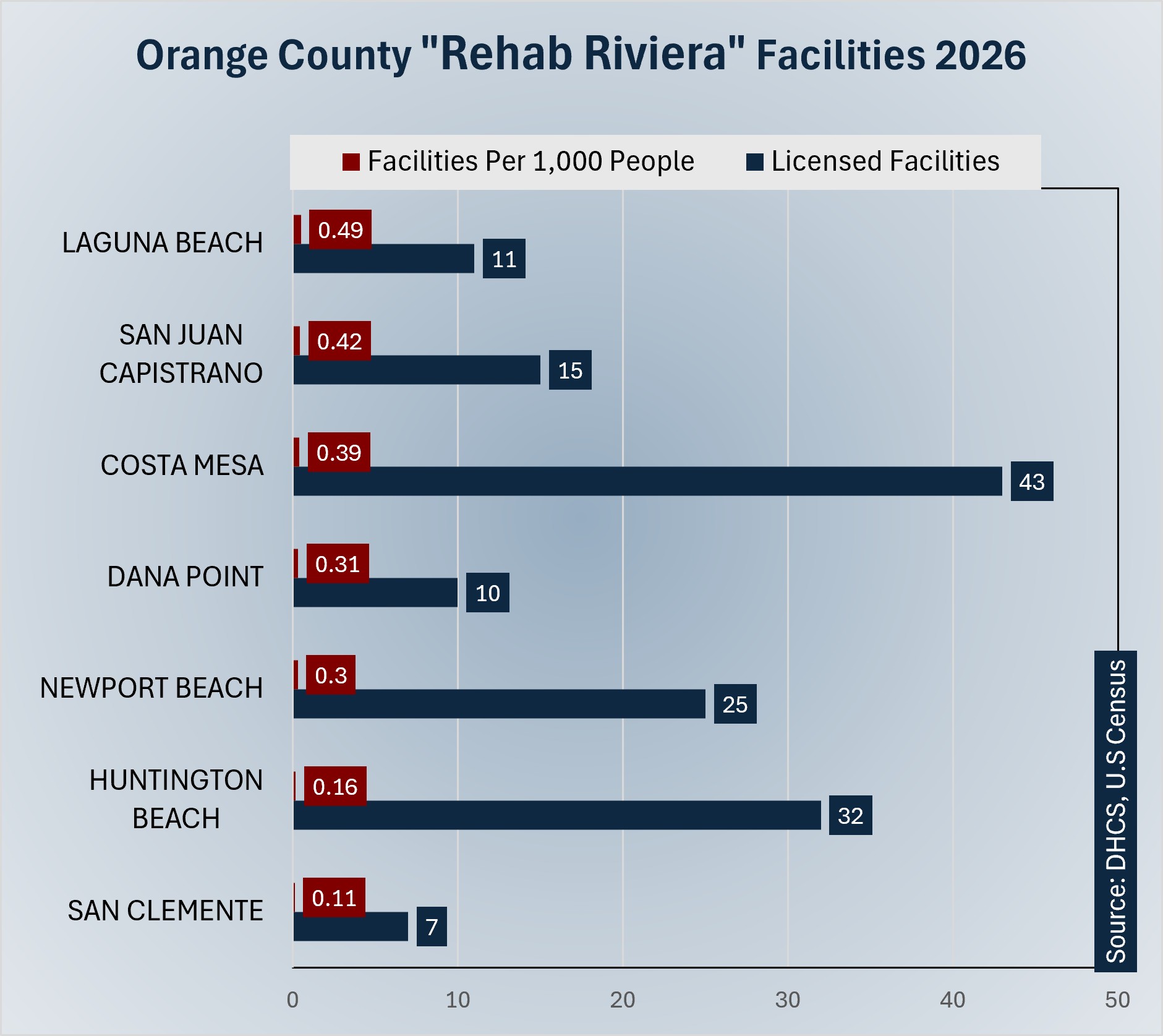
- For comparison, Anaheim, with 341,008 people, has 17 licensed drug rehabs in 2026, equating to .05 rehabs per 1,000 residents. Santa Ana has 26 rehabs and 315,586 in population, working out to .08 rehabs per 1,000. San Diego is home to 1,406.106 million people. It’s the address for 81 drug rehabs, but that works out to only .05 rehabs per 1,000 residents.
- Sober Living homes are usually unlicensed facilities and haven’t been accounted for in the numbers above. Their concentration in each city can be difficult to track, because some fly under the radar. In 2015, the Costa Mesa City Council claimed there were 107 sober living homes there, providing around 600 beds.
Where the Rehab Riviera Stands Now…
Costa Mesa is a good representative of the Orange Coast/ Rehab Riviera and its current situation. As seen above, the city doesn’t have nearly as many rehab facilities as it once did. It’s also starting to crack down on sober living homes.
City leaders have won recent court battles over the city’s intention to limit how many recovery residences can be on the same street, and to make all sober living homes earn permits. The fight has been over whether these restrictions violated California housing discrimination laws and other federal guidelines.
Costa Mesa’s court victory over one sober living owner was upheld in 2024, as reported by Voice of OC. Other coastal communities are expected to follow Costa Mesa’s lead to limit the number of homes allowed in residential areas.
Wrongful Death Lawsuits filed by grieving families continue to highlight the negligence of some facilities when it comes to patient safety.
The homelessness problem still plagues Substance Use Disorder (SUD) sufferers and Orange County cities. Many people from other areas who didn’t receive the help they needed and were kicked out of programs never left.
- In 2020, one measure was taken to help with this issue. California’s Assembly Bill 919 amended several sections of the Health and Safety Code. It required rehabs to provide travel money to patients who left the program. This money to return home is supposed to be available up to one year after the SUD patient is expelled from the facility.
Rehab Deserts: Places That Need More Drug Treatment Centers
SUD patients may come to Orange County for the sea air and the views, but they may also have no choice but to leave their hometowns. Their local communities may not have the drug treatment programs they need.
It’s the same for some residents in other California counties. They may have to travel to places like Orange County because their cities don’t have any drug treatment facilities. Or their towns could have facilities, but not enough beds to handle the demand for safe detox treatment.
For a recent study, our researchers decided to refer to these facilities as “rehab deserts.” It’s a handy term to describe places where cities may lose many residents to drug use each year and also lack the drug treatment centers to meet the tragic problem head-on.
You can read our study on the Rehab Deserts, spotlighting the communities, big and small, that could definitely use more treatment beds.